
How to Choose the Right Offshore Development Partner in 2025
A Strategic Guide to Finding a Long-Term Offshore Software Development Team
Table of Contents
- What Is an Offshore Development Partner?
- Key Criteria for Selecting an Offshore Development Partner
- Different Offshore Partnership Models to Consider
- Common Pitfalls to Avoid
- How to Evaluate Offshore Partners: Questions to Ask
- Is an Offshore Development Partner Right for Your Business?
- Conclusion
- FAQ: Offshore Development Partnerships
Choosing the wrong offshore development partner doesn't just cost money—it costs months of momentum. Delayed sprints, security incidents, handover breakdowns, and teams that quietly disengage are all too common when businesses rush this decision. The companies that get it right treat their offshore partner search like an executive hire: structured, rigorous, and never based on the lowest quote.
This guide is built for Australian tech leaders, CTOs, and founders who are serious about building a high-performing offshore software team—not just outsourcing tasks. We'll walk you through the exact criteria to evaluate, the engagement models to understand, the pitfalls to avoid, and the questions to ask before you sign anything.
Need help finding the right offshore partner?
Cipher Projects helps Australian businesses scale with dedicated offshore teams in Vietnam. Talk to our experts →
What Is an Offshore Development Partner?
An offshore development partner is not a freelance marketplace, a body shop, or a project vendor. It's a dedicated software team—located in another country—that operates as a genuine extension of your business. They follow your sprint cadence, adopt your tooling, align with your engineering culture, and build toward your product goals. The relationship is ongoing, not transactional.
This model—sometimes called an Offshore Development Centre (ODC)—sits distinctly apart from traditional outsourcing. In classic outsourcing, you hand a spec to a vendor and wait for a deliverable. With an offshore development partner, you're building a team that thinks alongside yours. Your offshore developers attend standups, contribute to architecture decisions, raise blockers early, and own outcomes rather than just tickets.
For Australian businesses specifically, this model has become a primary lever for engineering scale. Vietnam has emerged as the standout destination—combining strong English proficiency, AEST-compatible working hours (only 3–4 hours behind), a rapidly maturing tech talent pool, and significantly lower costs than Sydney or Melbourne hiring markets. Senior engineers in Vietnam typically cost 60–70% less than equivalent local talent, without any compromise on technical depth.
The result is a model that gives you control, continuity, and cost efficiency—the three things traditional outsourcing almost never delivers simultaneously.
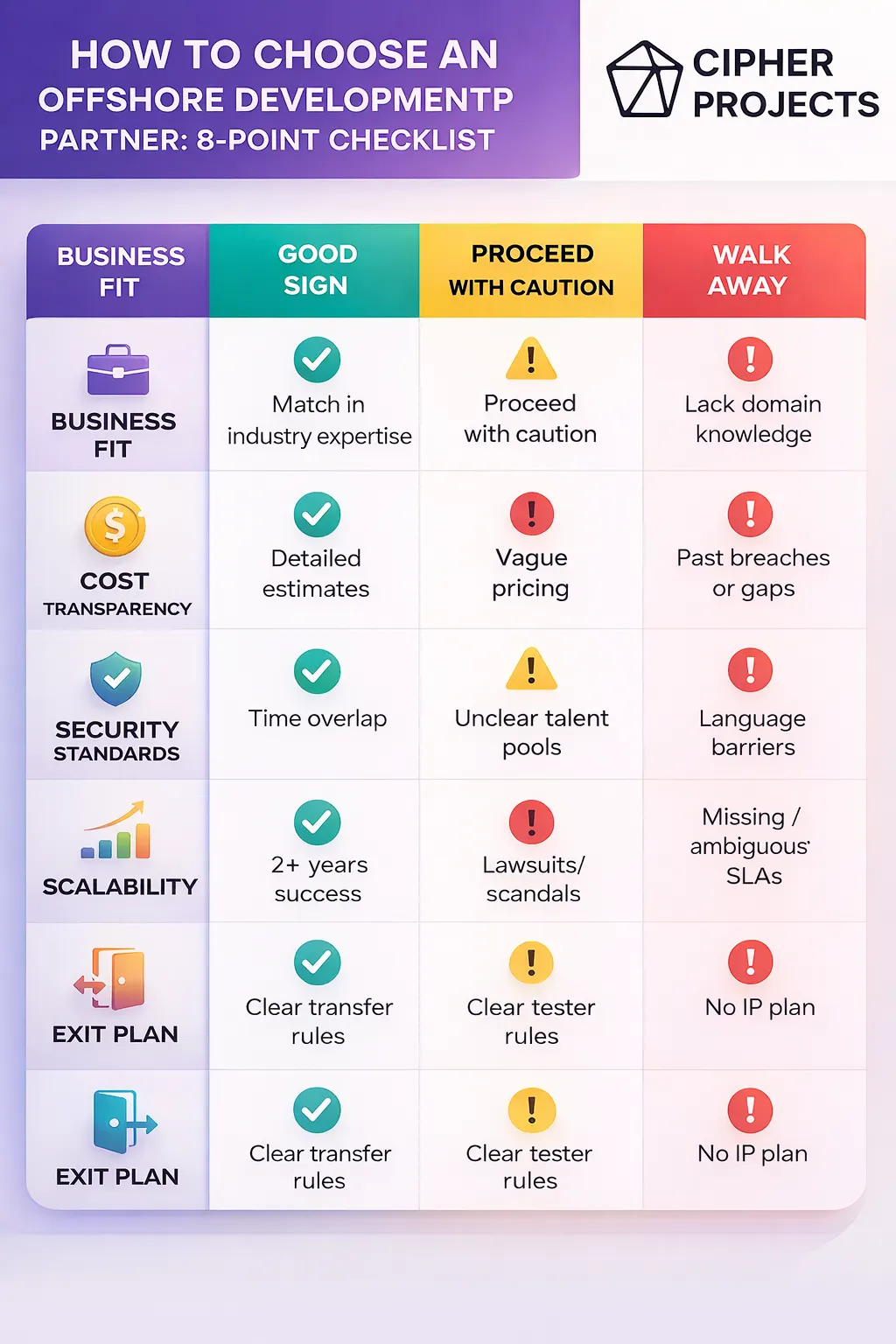
Key Criteria for Selecting an Offshore Development Partner
Most businesses evaluate offshore partners on price alone—and most regret it within six months. The selection process should be treated like hiring a senior leadership team member. Here are the eight criteria that actually predict whether a partnership will succeed long-term.
1. Business and Technical Fit
Technical capability is table stakes. The real differentiator is whether a vendor genuinely understands your business domain and can apply engineering decisions in context—not just execute tickets mechanically.
A team that has built fintech platforms thinks differently about authentication and audit trails than one that has only built e-commerce sites. A team experienced in regulated industries understands compliance constraints that a generalist vendor will treat as surprises mid-project. Domain familiarity accelerates delivery, reduces rework, and produces better architectural decisions from day one.
- Industry expertise: Has the vendor delivered for businesses in your sector? Ask for case studies that go beyond tech stack—look for evidence they understood the business problem, not just built to a spec.
- Technical proficiency: Can they work fluently in your stack—not just claim familiarity with it? Run a technical interview with actual engineers, not a pre-sales demo.
- Cultural compatibility: Do they default to proactive communication or wait to be told? Do they push back on bad requirements, or just build what they're handed? Mindset matters more than timezone.
- Team seniority balance: A team of juniors supervised by a remote lead is not a partner—it's a cost-cutting exercise. Verify the ratio of senior to mid-level engineers on your proposed team.
Tip: Request a live technical walkthrough of a past project, not just a PDF case study. Ask the engineers who built it to walk you through the decisions they made and why. That conversation reveals more about capability than any portfolio page.
2. Cost Structure and Transparency
The cheapest offshore quote is rarely the cheapest outcome. Hidden costs—management overhead, onboarding churn, rework from miscommunication, and the time you spend managing an underperforming vendor—often dwarf the initial rate savings.
A trustworthy offshore partner publishes a clear, itemised cost structure with no ambiguity about what's included. You should know exactly what you're paying for: engineering time, infrastructure, HR support, management, equipment, and office overhead. Anything vague in the pricing conversation will become a dispute later.
Think about total cost of engagement, not just hourly rates. A team at $45/hr that requires constant re-briefing and produces work that needs heavy revision from your local engineers is more expensive than a team at $65/hr that ships clean, production-ready code with minimal oversight.
- Transparent pricing models: Insist on a written breakdown of all cost components before signing. If a vendor is evasive about what's included in their rate, that is a red flag.
- Value vs. rate assessment: Model the total cost of engagement over 12 months, not just the monthly retainer. Include your internal management time, onboarding costs, and expected rework overhead.
- Scaling cost structure: Understand exactly how costs change when you add or remove team members. Some vendors charge significant premiums for rapid scaling; others absorb that into their model.
- Currency and payment terms: Clarify invoicing currency, payment frequency, and what protections exist if exchange rates shift significantly.
Tip: Ask the vendor to walk you through the last time a client's scope changed significantly mid-engagement. How did pricing adjust? Was the client informed proactively? Their answer tells you everything about how they handle commercial surprises.
3. Security and Compliance Standards
Your offshore team will have access to proprietary source code, internal systems, customer data, and potentially regulated information. Security is not an afterthought—it's a foundational requirement that must be validated before any engagement begins.
The consequences of getting this wrong are severe: IP theft, data breaches, regulatory penalties, and reputational damage. Australian businesses operating in healthcare, fintech, or government sectors face particularly stringent obligations under frameworks like the Privacy Act, APRA CPS 234, and various state-level data protection regulations. Your offshore partner's security posture must be compatible with these obligations.
- Certifications and frameworks: Look for ISO 27001 certification as a minimum baseline. If you handle payment data, verify PCI DSS alignment. For government work, ask about specific compliance frameworks they've operated within.
- Access control and device management: Who has access to your codebase? How is that access provisioned, monitored, and revoked when a team member leaves? Are developer devices managed and encrypted?
- Intellectual property protections: Ensure your contract explicitly assigns all IP to you, not the vendor. Include NDAs for every team member, not just at the company level.
- Incident response: Ask for their documented security incident response process. A vendor who has never thought about this is a vendor who hasn't been tested yet.
- Network and physical security: Is the development environment separated from public internet access? Are there documented policies for BYOD, VPN use, and remote work security?
Tip: Send a security questionnaire before the commercial conversation—not after. A vendor who takes it seriously will respond thoroughly and promptly. One who treats it as a checkbox exercise is telling you exactly how they'll handle your data.
4. Communication and Collaboration
More offshore partnerships fail because of communication breakdowns than technical failures. A team that builds the wrong thing confidently is more dangerous than one that asks clarifying questions. The ability to communicate problems early, flag risks proactively, and push back on unclear requirements is what separates a true engineering partner from a body shop.
Communication quality is also harder to assess than technical skill—you can run a coding challenge, but gauging whether a team will proactively flag a bad architectural decision at 9am before it becomes a regression at 4pm takes deliberate evaluation.
- Overlap hours: How many hours per day does their working day overlap with yours? For Australian businesses working with Vietnam-based teams, the overlap is typically 3–5 hours depending on your hours, which is sufficient for daily standups and real-time collaboration on blockers.
- Async communication quality: Request samples of how their team documents decisions, writes tickets, and communicates progress in writing. Async quality often predicts partnership quality better than calls do.
- Tooling alignment: Do they work natively in the tools you already use—Jira, Linear, Slack, GitHub, Notion—or will they require you to adopt their workflow? The best partners adapt to your system, not the other way around.
- English language depth: Written fluency matters more than spoken fluency for day-to-day collaboration. Assess both, but weigh written communication heavily—that's where requirements get misunderstood and blockers go unraised.
- Escalation paths: Is there a dedicated account manager or delivery lead who bridges your team and theirs? You should never be chasing a vendor for status updates.
Tip: Before signing, run a two-week paid trial sprint with a small scope. Real collaboration under actual delivery pressure will reveal communication patterns that no interview can surface. If a vendor won't do a paid trial, ask why.
5. Scalability and Flexibility
The business environment that justifies hiring your offshore team today will not be the same environment six months from now. Your product roadmap will shift, funding rounds change headcount needs overnight, and new technology requirements emerge. Your offshore partner must be able to move with you—not lock you into a static team structure.
Scalability is not just about headcount. It's about the partner's ability to introduce new specialisations (ML engineers, DevOps, security specialists), absorb scope changes without commercial chaos, and maintain team quality under growth pressure. Partners who scale by throwing junior resources at problems are not scaling—they're diluting.
- Time-to-hire benchmarks: Ask how long it typically takes to onboard a new developer at senior, mid, and junior levels. For urgent scaling needs, what's their record for filling roles under a 2-week timeline?
- Talent pipeline depth: A partner with a proprietary talent pipeline can move faster and maintain quality better than one that relies on the open market every time you need to grow.
- Specialisation breadth: Can they source engineers with niche skills—Rust, Solidity, ML pipelines, embedded systems—or are they limited to mainstream web/mobile stacks?
- Ramp-down flexibility: Business needs contract as well as expand. Understand the minimum notice period for scaling down and whether there are financial penalties for reductions.
- Model flexibility: Can they shift between engagement models (dedicated team to staff augmentation, for example) as your needs evolve without requiring a full commercial renegotiation?
Tip: Ask a potential partner to describe in detail the last time a client needed to double their team size in under 60 days. What was the process? What quality controls stayed in place? How did the new engineers get up to speed? The specificity of their answer will tell you whether they've actually done it.
6. Reputation and References
Every vendor looks excellent on their own website. References and verified third-party reviews are the only way to understand what working with them actually looks like—especially when things go wrong. Because things will go wrong, and how a partner responds to adversity is a better predictor of long-term success than how they perform when everything is smooth.
Look for longevity in client relationships. A vendor with five clients who've been with them for three or more years tells a very different story than one with fifty one-year engagements. Retention is the ultimate quality signal in this industry.
- Third-party review platforms: Check Clutch, GoodFirms, and G2 for verified reviews. Read the negative reviews carefully—look for patterns. One bad review is noise; three reviews citing the same issue is signal.
- Direct reference calls: Ask the vendor for references and then go beyond those references. Use LinkedIn to find former clients they didn't list and reach out directly. Ask about what went wrong, not just what went right.
- Client tenure distribution: What is the average length of their client relationships? What percentage of their revenue comes from clients they've had for 2+ years? High retention is a proxy for consistent delivery quality.
- Industry recognition: Awards from Deloitte Fast 500, regional tech associations, or government export programs add credibility—though they should supplement reference checks, not replace them.
Tip: When speaking to references, ask specifically: "Describe the worst period in your engagement with this vendor, and how they handled it." The answer to that question is worth more than a hundred positive testimonials.
7. Service Level Agreements
A handshake agreement on "quality" and "responsiveness" is not an SLA—it's a recipe for disputes. Before any engagement starts, you need written, measurable commitments that define what good looks like and what happens when it's not delivered.
SLAs serve two purposes: they set clear expectations, and they create accountability mechanisms that protect both parties. A vendor who resists specific SLAs is a vendor who knows they can't meet them. A vendor who proposes them proactively is one who's confident in their delivery.
- Response time SLAs: How quickly will a designated contact respond to critical issues? What constitutes a P1 incident, and what is the escalation path? Define this in writing before day one.
- Velocity and throughput commitments: While it's difficult to define story point velocity upfront, you can agree on sprint ceremony participation, retrospective cadence, and PR review turnaround times.
- Code quality standards: Define minimum requirements for test coverage, code review processes, documentation standards, and CI pipeline requirements. These should be contractual, not aspirational.
- Reporting cadence: Weekly written status reports, monthly business reviews, quarterly strategic check-ins—define the rhythm before you start, not after you realise you're in the dark.
- Penalty and remedy clauses: What happens when SLAs are missed? Define both the consequence and the remedy process. Balance penalties with incentives for exceeding targets—you want a partner motivated to excel, not just avoid failure.
Tip: Build a 30/60/90-day review structure into your SLA framework. The first three months of an engagement reveal gaps in the original agreement that you'll want the ability to renegotiate without commercial conflict.
8. Exit Strategy and Risk Management
Nobody enters a partnership planning its end—but the most sophisticated buyers build exit provisions in from the start. Not because they expect to leave, but because the ability to exit cleanly is what makes it safe to enter. A vendor who resists exit provisions is one who expects to make transition difficult.
The primary risk in exit is knowledge concentration: if your codebase is undocumented, your systems are not versioned cleanly, and your processes live only in the heads of offshore team members, a transition becomes catastrophic rather than operational. Good offshore partners make themselves replaceable as a function of how they work—documentation, clean architecture, and transfer-ready knowledge management should be standard practice, not emergency procedures.
- IP ownership clarity: Your contract must unambiguously assign all developed IP, code, and related assets to you upon creation—not upon payment or upon termination. This is non-negotiable.
- Knowledge documentation requirements: Define contractual standards for documentation. Architecture decision records, onboarding runbooks, and inline code documentation should be deliverables, not nice-to-haves.
- Transition period obligations: How many weeks of handover support will they provide upon notice? Who provides it? What's included? Define this in your contract, including whether transition support is included in the rate or billed separately.
- Minimum notice periods: Both parties need clarity on notice requirements. Thirty days is common for individual resource changes; 60–90 days is more appropriate for full team transitions.
- Continuity risk mitigation: What's the plan if a key team member leaves your project? How does the vendor handle knowledge transfer internally, and how quickly can they replace a departing senior engineer?
Tip: Include a "clean exit" clause that specifies the vendor's obligation to deliver all code in a deployable, documented state within 30 days of notice—regardless of circumstances. If a vendor won't agree to this, ask why.
Different Offshore Partnership Models to Consider
Not all offshore engagement structures are created equal, and the right model depends on your organisation's size, risk appetite, desired control level, and long-term intentions. Understanding the trade-offs upfront prevents a costly model mismatch six months in.
Contractor Model (Managed Services)
The vendor owns and operates the development centre. They handle HR, payroll, legal compliance, office infrastructure, and team management—while you maintain control over what the team builds and how they prioritise. This is the lowest-friction entry point for most Australian businesses entering offshore for the first time.
Best for: Companies that want offshore talent without the overhead of running a foreign entity. You get a dedicated team without the administrative complexity of direct employment in another country.
Trade-off: You have less direct control over HR practices, hiring standards, and team culture. You're dependent on the vendor's management quality.
Customer-Owned Model (Subsidiary)
Your company establishes a legal entity in the offshore country and directly employs the team. This gives you maximum control—over hiring, culture, compensation, and strategic direction—but requires significant upfront investment in legal setup, HR infrastructure, and operational management.
Best for: Large enterprises with 20+ offshore headcount planned, long-term offshore commitments of 5+ years, and existing HR/legal capability to manage a foreign subsidiary.
Trade-off: High setup cost (typically $50k–$150k AUD), 6–12 month establishment timeline, and ongoing compliance obligations in the host country.
Build-Operate-Transfer (BOT) Model
A hybrid approach where a vendor partner establishes and operates the offshore centre on your behalf for an agreed period—typically 12–36 months—after which full ownership and operational control transfers to your company. You get the expertise of a managed partner in the setup phase, with a clear path to independence.
Best for: Companies with a long-term vision for a significant offshore presence who want to de-risk the establishment phase and learn from an experienced operator before taking the wheel.
Trade-off: More complex commercially than a straight managed service. Transition points require careful planning. The quality of transfer depends heavily on how well the operating period has been managed.
Dedicated Team Model (Staff Augmentation)
Individual engineers or small teams are embedded directly into your existing product organisation. They work in your tools, attend your ceremonies, and report into your engineering managers—they just happen to be located offshore. There's no separate physical office; the talent is the service.
Best for: Companies with strong internal engineering leadership who need to extend capacity quickly without standing up a separate operational unit. Ideal for filling specific skill gaps or augmenting existing teams on defined workstreams.
Trade-off: Requires more active management from your internal leads. Cultural integration takes deliberate effort. Not suited for companies without internal engineering management capability.
Common Pitfalls to Avoid
The offshore development market is littered with failed partnerships that looked excellent on paper. These are the failure patterns we see most consistently—and the specific actions you can take to avoid them.
- Choosing on price alone: The cheapest vendor in your shortlist is almost never the best value at 12 months. When you factor in rework, management overhead, communication friction, and turnover, low-rate teams frequently cost more than premium ones. Model total cost of engagement, not hourly rates.
- Skipping the technical interview: Sales presentations and portfolio sites are curated. Run a real technical assessment with the engineers who will actually work on your project—not with solutions architects or pre-sales engineers. What you see in the interview is what you'll get in production.
- Vendor lock-in by design: Some vendors structure engagements to make exit deliberately painful—proprietary tooling, undocumented code, and unclear IP terms are all mechanisms that transfer leverage away from you. Prioritise vendors who make themselves replaceable as a quality signal, not a risk.
- Underinvesting in onboarding: An offshore team that doesn't deeply understand your product, your users, and your architecture will default to literal interpretation of requirements. A poorly onboarded team builds exactly what you ask for, not what you need. Budget two to four weeks of deliberate onboarding before expecting full velocity.
- Overlooking cultural communication norms: In many Southeast Asian development cultures, team members are less likely to proactively escalate problems or push back on unclear requirements—not because they don't see the issues, but because escalation can feel culturally uncomfortable. Build explicit structures (weekly blockers reviews, anonymous feedback channels) that make it safe and expected to raise problems early.
- Setting and forgetting: Offshore teams that deliver consistently do so because their clients invest in the relationship. Regular strategic reviews, occasional in-person visits, and treating offshore team members as genuine colleagues rather than remote contractors drives retention, motivation, and output quality.
- Unrealistic timeline expectations: Offshore development is not a switch you flip. Ramp-up time, onboarding, and relationship establishment mean that most teams don't hit full productive velocity for 4–8 weeks. Budget for this in your project timeline.
How to Evaluate Offshore Partners: Questions to Ask
Beyond the standard RFP process, these are the questions that reveal whether a vendor is the right long-term partner—not just the best presenter in the shortlist.
- "Walk me through your process when a client's requirements change significantly mid-sprint. What happened the last time this occurred?"
- "What's your average engineer tenure? What's your annual attrition rate, and how does it compare to your market?"
- "Describe the most significant technical failure that occurred on a client project. What was your role in it, and what changed as a result?"
- "How do you handle a situation where your team identifies a requirement that will cause problems downstream, but the client is insisting on proceeding?"
- "What does your onboarding process look like for a new client? Who is involved, and what does success look like at 30 days?"
- "If we needed to add three senior engineers within 30 days, what would that process look like right now? Who would they be?"
- "What does your documentation standard look like? Can I see an example of a README or architecture document from a comparable project?"
Vendors who answer these questions with specificity and candour—including admitting past failures—are the ones worth trusting. Vendors who respond with polished generalities are optimising for the sale, not the partnership.
Is an Offshore Development Partner Right for Your Business?
Offshore development is not the right move for every business at every stage. Here's an honest assessment of when it makes strategic sense—and when it doesn't.
It's likely the right move if you:
- Have a defined product roadmap requiring sustained engineering output over 12+ months
- Are facing local talent shortages in specialisations like cloud architecture, ML, or mobile development
- Need to reduce your engineering cost base without reducing delivery capacity
- Have internal engineering leadership capable of managing a distributed team
- Are scaling a product that requires flexible team size as features ship and priorities shift
- Want to operate across extended hours without the cost of local shift work or on-call premiums
It may not be the right move if you:
- Need to ship an MVP in under 8 weeks—the ramp-up time works against very short horizons
- Have no internal engineering leadership to manage an offshore team's output
- Are working with highly regulated data where offshore data access creates unacceptable compliance exposure
- Have previously had a negative offshore experience but haven't identified what structurally caused it—repeating the same process with a different vendor rarely produces a different result
For most scaling Australian tech businesses, the question isn't whether to engage offshore—it's when and how. Getting the structural and partner decisions right before you sign determines whether offshore becomes a growth accelerant or an expensive distraction.
Conclusion
The offshore development market has matured significantly. The era of "cheap code from overseas" is over for businesses that know what they're doing. Today, the best offshore partnerships operate as genuine strategic relationships—where offshore engineers are embedded in product strategy, not just task execution, and where the quality of output is indistinguishable from in-house work.
Reaching that standard requires a deliberate selection process. It requires looking past the pitch deck to the actual engineers. It requires contractual clarity on IP, SLAs, and exit. And it requires an internal commitment to treating your offshore team as colleagues rather than contractors.
The businesses that invest that care upfront consistently report the same outcomes: lower engineering costs, faster delivery, and access to talent depth that simply doesn't exist in their local market. The businesses that rush it report the opposite.
Take the time to get this right. The right offshore development partner doesn't just reduce your costs—they change what your business can build.
FAQ: Offshore Development Partnerships
What is the difference between offshore and nearshore development partners?
Offshore development partners are located in distant countries—like Vietnam or India for Australian businesses—and offer maximum cost efficiency, often 60–70% savings on senior engineering talent. The trade-off is larger time zone differences, though countries like Vietnam sit only 3–4 hours behind AEST, making real-time collaboration very workable. Nearshore partners are geographically closer with smaller time zone gaps, but typically at significantly higher cost than offshore options and without the depth of technical talent available in major Southeast Asian markets.
How much can I save with an offshore development partner?
Australian businesses typically save 50–70% on engineering costs when partnering with offshore teams in Vietnam, compared to equivalent Sydney or Melbourne hiring. A senior full-stack engineer in Australia might cost $150,000–$180,000 AUD per year in total employment cost. An equivalent engineer on a Vietnamese offshore team typically costs $40,000–$60,000 AUD annually through a managed partner. The savings compound at team scale: a five-person offshore team can deliver the same output as a three-person local team at a fraction of the cost, while also providing the flexibility to scale up or down without the risk of local redundancies.
What are the biggest risks when working with offshore development partners?
The most common risks are communication breakdown, IP exposure, quality inconsistency, and engineer attrition. Communication risks are mitigated by choosing partners with strong written English, structured async workflows, and dedicated delivery management. IP risks are addressed through contractual IP assignment clauses and NDAs at the individual engineer level. Quality inconsistency typically stems from poor onboarding and insufficient internal engineering leadership—investing four weeks in proper onboarding and maintaining an engaged internal tech lead resolves most quality issues. Attrition risk is best evaluated through a vendor's disclosed annual turnover rate; anything above 20% annually is a red flag in this industry.
How long does it take to get an offshore development team up to speed?
Realistically, plan for four to eight weeks before an offshore team is operating at full productive velocity. The first two weeks focus on environment setup, codebase orientation, and establishing communication rhythms. Weeks three and four involve working through smaller, lower-risk tasks to build context and identify any process gaps. By week five or six, a well-onboarded team should be delivering at close to full capacity. Teams that are rushed into complex work in week one consistently underperform and require more management overhead over the long term. The best offshore partners have a structured onboarding playbook—ask to see it before you sign.
Should I do a trial project before committing to an offshore partner?
Yes—and it should be a paid trial, not a free proof-of-concept. A paid two to four week trial sprint with a defined scope and real deliverables gives you an accurate picture of how a team communicates, how they handle ambiguity, how clean their code is, and how they behave when something goes wrong. Free trials attract effort proportional to their value—paid trials reveal the team's actual working standards. Any reputable offshore development partner will agree to a paid trial. If they resist or insist on a long-term commitment before letting you evaluate their work, treat that as a significant red flag.
Why do Australian businesses choose Vietnam for offshore development?
Vietnam has become the preferred offshore destination for Australian tech businesses for several converging reasons. Timezone alignment is excellent—Ho Chi Minh City and Hanoi sit only 3–4 hours behind AEST, enabling genuine real-time collaboration across a full working day overlap. English proficiency has improved dramatically over the past decade, particularly among university-educated engineers in major tech hubs. The technical talent pool is deep and growing: Vietnam produces over 50,000 STEM graduates annually, with a strong culture of continuous learning. Cost efficiency is significant—senior Vietnamese engineers typically cost 60–70% less than Australian equivalents. And culturally, Vietnamese engineers are known for strong work ethic, attention to detail, and long-term loyalty to employers who invest in them.
Related Resources
To gain a comprehensive understanding of offshore software development strategies, explore these related articles:
- Offshore Development Centre: A Strategic Approach to Global Talent Acquisition - Learn about different ODC models and their benefits
- Building Successful Offshore Development Teams in 2025: An Australian Business Guide - Learn about the Australian management advantage in offshore teams
- How to Find Remote Software Teams: Complete Guide 2025 - Strategies for finding and hiring remote development talent
Need Help Finding the Right Offshore Development Partner?
Cipher Projects specialises in connecting Australian businesses with high-performing offshore development teams in Vietnam. We've done the due diligence so you don't have to—our partners are vetted on technical quality, communication standards, security practices, and long-term client retention. Whether you're evaluating your first offshore engagement or looking to replace an underperforming vendor, we can help you move faster and with more confidence.
Schedule a ConsultationNeed Expert Help With Your Project?
Our team of specialists is ready to help you implement the strategies discussed in this article and address your specific business challenges.